import numpy as np
import matplotlib.pyplot as plt

import imcombiners as imc06 Offset Stacking
This tutorial shows how to use place_into_padded() when the object you want to keep is moving across otherwise fixed stars.
The important convention is axis order:
- Images are NumPy arrays indexed as
image[y, x]. place_into_padded(images, offsets)expects offsets in Python order:(dy, dx), not(x, y).- Positive
dyplaces an image at larger row indices. - Positive
dxplaces an image at larger column indices.
That differs from the usual FITS/WCS habit of describing positions as (x, y). When you start from an image-plane velocity vector (vx, vy), convert it to an offset vector as (dy, dx) = (vy, vx).
1. Make Stack
We make nine 100×100 images. The stars are fixed in detector coordinates. The asteroid is an elliptical Gaussian whose center moves as
\[ \vec{x}(t) = \vec{x}_0 + \vec{v}_0 t. \]
Here v0 has length 5 pixels per frame at 150 degrees counter-clockwise from the image +x direction. In (x, y) this is roughly (-4.33, +2.50) pixels per frame.
ny, nx = 100, 100
n_frames = 9
dt = 1.0
speed = 5.0
theta = np.deg2rad(150.0)
vx = speed * np.cos(theta)
vy = speed * np.sin(theta)

x0, y0 = 72.0, 36.0
times = np.arange(n_frames, dtype=np.float32) * dt
asteroid_xy = np.column_stack([x0 + vx * times, y0 + vy * times])

print(f"v0 in (x, y): ({vx:.2f}, {vy:.2f}) px/frame")
print(f"v0 in Python (dy, dx): ({vy:.2f}, {vx:.2f}) px/frame")
v0 in (x, y): (-4.33, 2.50) px/frame
v0 in Python (dy, dx): (2.50, -4.33) px/framey, x = np.mgrid[:ny, :nx]
def gaussian_star(xc, yc, amp=900.0, sigma=1.3):
r2 = (x - xc) ** 2 + (y - yc) ** 2
return amp * np.exp(-0.5 * r2 / sigma**2)
def elliptical_asteroid(xc, yc, amp=50.0, sigma_major=3.5, sigma_minor=1.1, angle_deg=150.0):
angle = np.deg2rad(angle_deg)
cos_a = np.cos(angle)
sin_a = np.sin(angle)
dx = x - xc
dy = y - yc
major = dx * cos_a + dy * sin_a
minor = -dx * sin_a + dy * cos_a
return amp * np.exp(-0.5 * ((major / sigma_major) ** 2 + (minor / sigma_minor) ** 2))
stars = np.zeros((ny, nx), dtype=np.float32)
for sx, sy, amp in [
(18.0, 20.0, 95.0),
(38.0, 76.0, 80.0),
(55.0, 48.0, 110.0),
(82.0, 82.0, 75.0),
(70.0, 18.0, 90.0),
]:
stars += gaussian_star(sx, sy, amp=amp)
rng = np.random.default_rng(20250311)
frames = []
for xc, yc in asteroid_xy:
image = 50.0 + stars + elliptical_asteroid(xc, yc)
image += rng.poisson(np.sqrt(image)) # Poisson noise
image += rng.normal(0.0, 4.0, size=(ny, nx))
frames.append(image.astype(np.float32))
stack = np.stack(frames)fig, axes = plt.subplots(1, 3, figsize=(10.5, 3.2), sharex=True, sharey=True)
for ax, idx in zip(axes, [0, n_frames // 2, n_frames - 1]):
ax.imshow(stack[idx], origin="lower")
ax.scatter(asteroid_xy[idx, 0], asteroid_xy[idx, 1], s=35, facecolors="none", edgecolors="tab:red")
ax.set_title(f"Frame {idx}")
plt.tight_layout()
plt.show()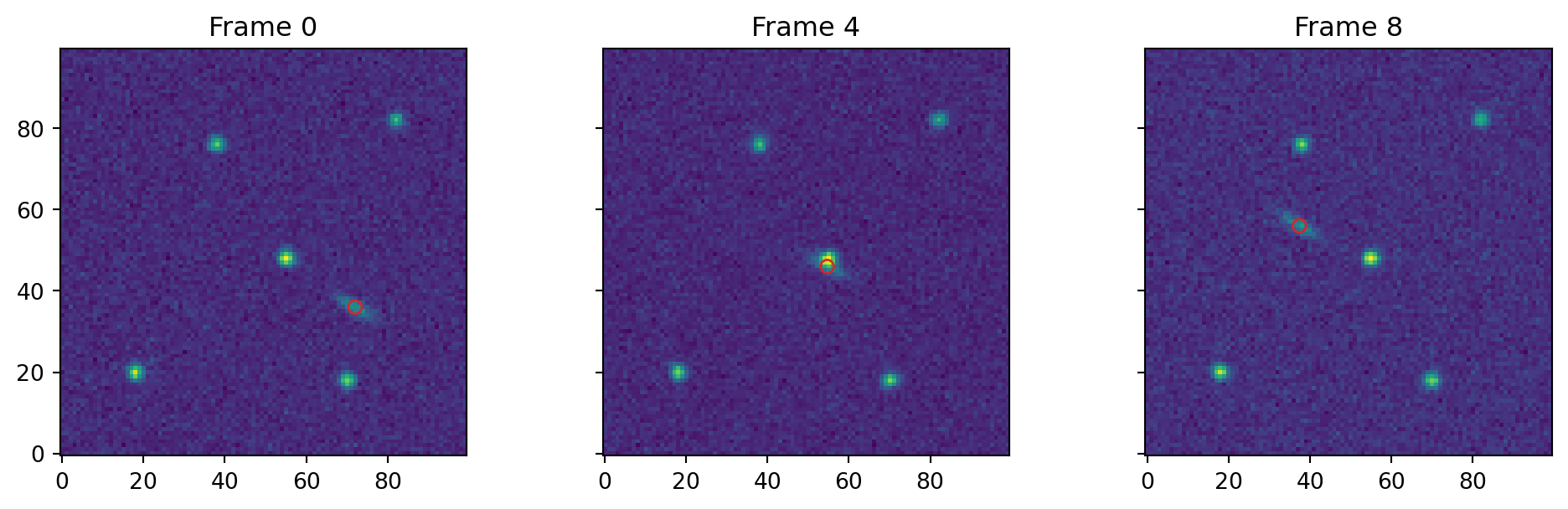
2. Star Frame With Standard Combiner
A normal median combine keeps fixed stars and rejects or strongly suppresses the moving asteroid because it lands on different pixels in each frame.
cmb_star = imc.Combiner(stack)
star_frame = cmb_star.combine("median")
3. Object Frame
To keep the asteroid, place each frame into a padded output stack with offsets that cancel the asteroid motion.
The asteroid displacement in image coordinates is (dx, dy) = (vx*t, vy*t). The placement offset must be the negative displacement, converted to Python order:
\[ (\mathrm{offset}_y, \mathrm{offset}_x) = \mathrm{round}(-v_y t,\ -v_x t). \]
Rounding is required because place_into_padded() currently implements integer pixel offsets only. This is enough to show the frame-tracking behavior; subpixel registration would need interpolation before padding.
offsets_yx = np.rint(np.column_stack([-vy * times, -vx * times])).astype(np.int64)
print(offsets_yx)
[[ 0 0]
[ -2 4]
[ -5 9]
[ -7 13]
[-10 17]
[-12 22]
[-15 26]
[-17 30]
[-20 35]]asteroid_stack = imc.place_into_padded(list(stack), offsets_yx)
cmb_asteroid = imc.Combiner(asteroid_stack)
asteroid_frame = cmb_asteroid.combine("median")4. Compare Outputs
The fixed-star median has compact stars and little asteroid signal. The asteroid-rate median keeps the asteroid near one location and smears/rejects the stars because their positions move in the asteroid frame.
fig, axes = plt.subplots(1, 2, figsize=(9, 4), sharex=False, sharey=False)

axes[0].imshow(star_frame, origin="lower")
axes[0].plot(asteroid_xy[:, 0], asteroid_xy[:, 1], "o-", color="tab:red", ms=3)
axes[0].set_title("Median in star frame")

axes[1].imshow(asteroid_frame, origin="lower")
axes[1].set_title("Median in asteroid frame")

for ax in axes:
    ax.set_xlabel("x")
    ax.set_ylabel("y")

plt.tight_layout()
plt.show()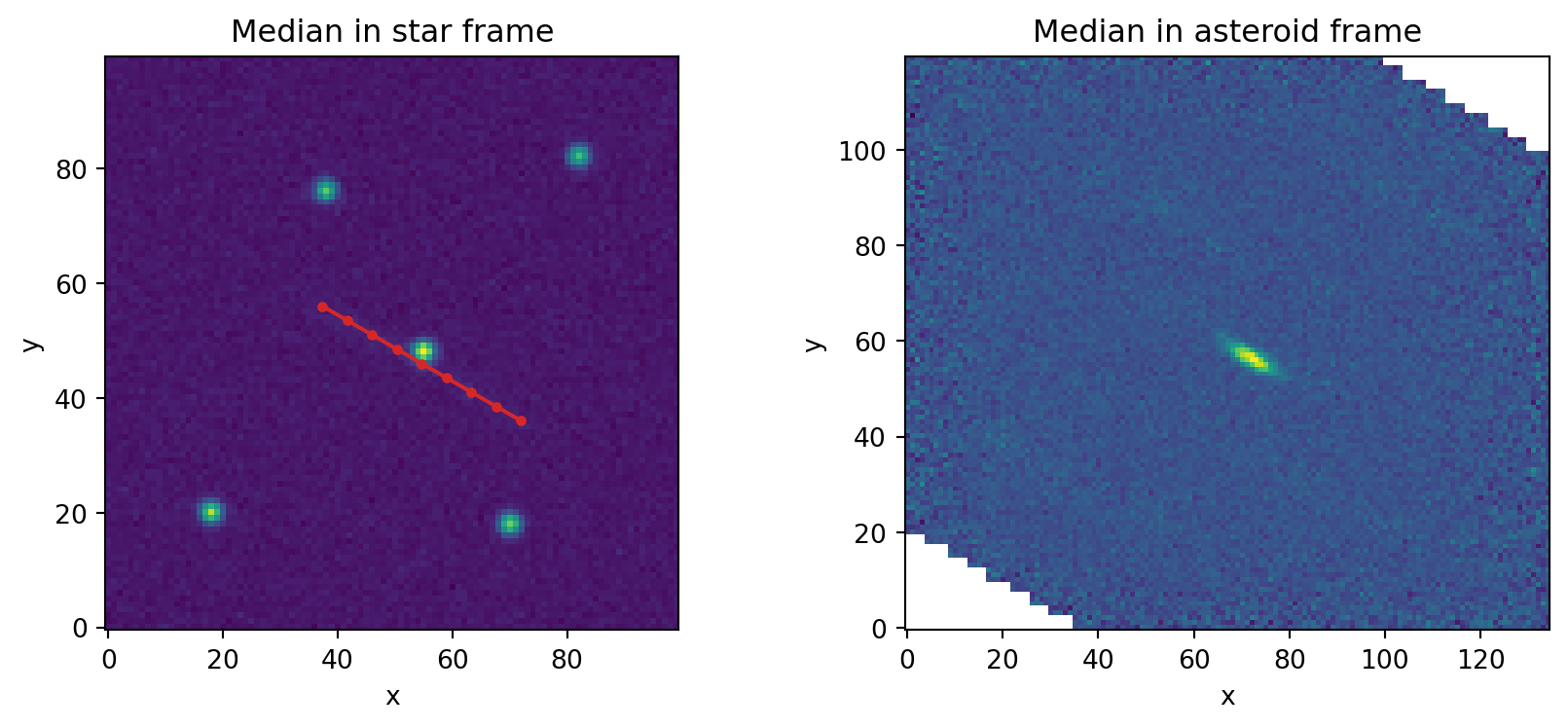
We can also compare small cutouts around the asteroid-track stack. The asteroid-frame cutout is compact; the star-frame cutout contains only weak residuals because the asteroid was rejected by the median.
norm_offsets = offsets_yx - offsets_yx.min(axis=0)
tracked_center_yx = np.rint(
    np.array([asteroid_xy[0, 1], asteroid_xy[0, 0]]) + norm_offsets[0]
).astype(int)
cy, cx = tracked_center_yx

half = 12
asteroid_cutout = asteroid_frame[cy - half : cy + half + 1, cx - half : cx + half + 1]

mid_idx = n_frames // 2
star_cy, star_cx = np.rint([asteroid_xy[mid_idx, 1], asteroid_xy[mid_idx, 0]]).astype(int)
star_cutout = star_frame[star_cy - half : star_cy + half + 1, star_cx - half : star_cx + half + 1]

fig, axes = plt.subplots(1, 2, figsize=(7, 3.4))
axes[0].imshow(star_cutout, origin="lower")
axes[0].set_title("Star-frame cutout")
axes[1].imshow(asteroid_cutout, origin="lower")
axes[1].set_title("Asteroid-frame cutout")
plt.tight_layout()
plt.show()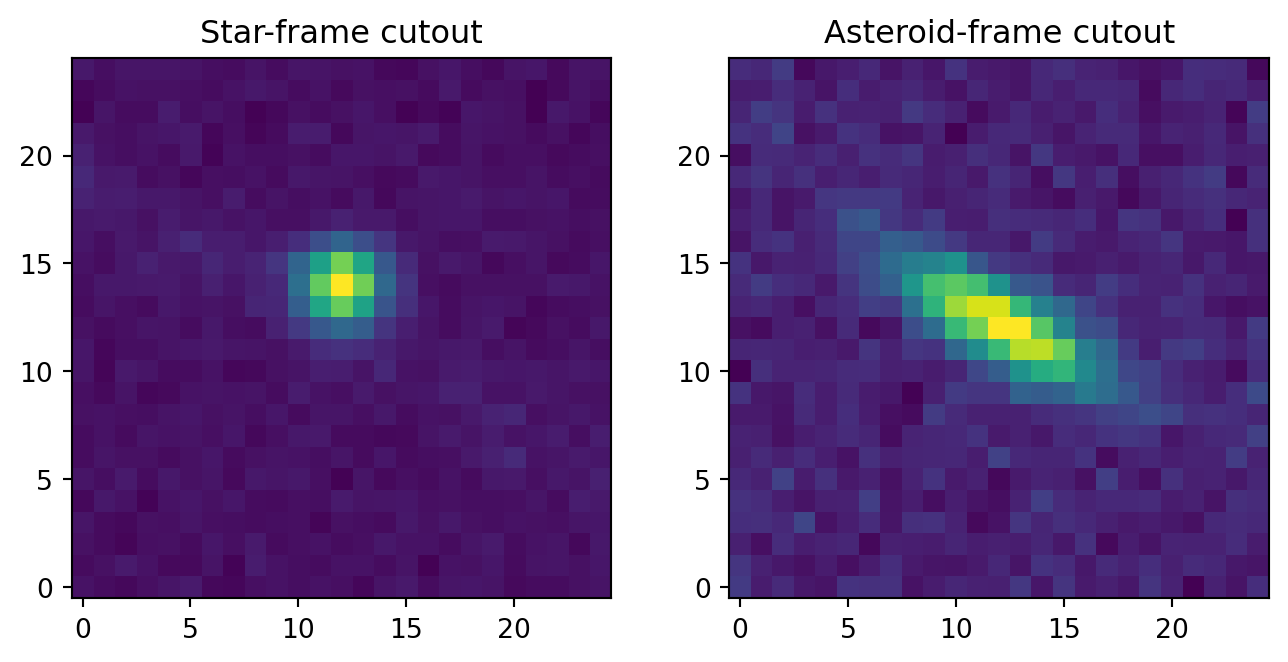
The same sign convention applies in real data. If an object moves by (+dx, +dy) pixels between frames, pass offsets close to (-dy, -dx) so the object lands at the same padded-stack coordinate before combining.
5. Prepared Workspace Check
After place_into_padded() has prepared a floating stack, the same workspace can be passed through Combiner without another copy:
asteroid_low = imc.Combiner(asteroid_stack, copy=False, validate=False).combine("median")

np.testing.assert_allclose(asteroid_frame, asteroid_low)
print("prepared workspace matches the Standard Combiner median.")
prepared workspace matches the Standard Combiner median.