imcombiners
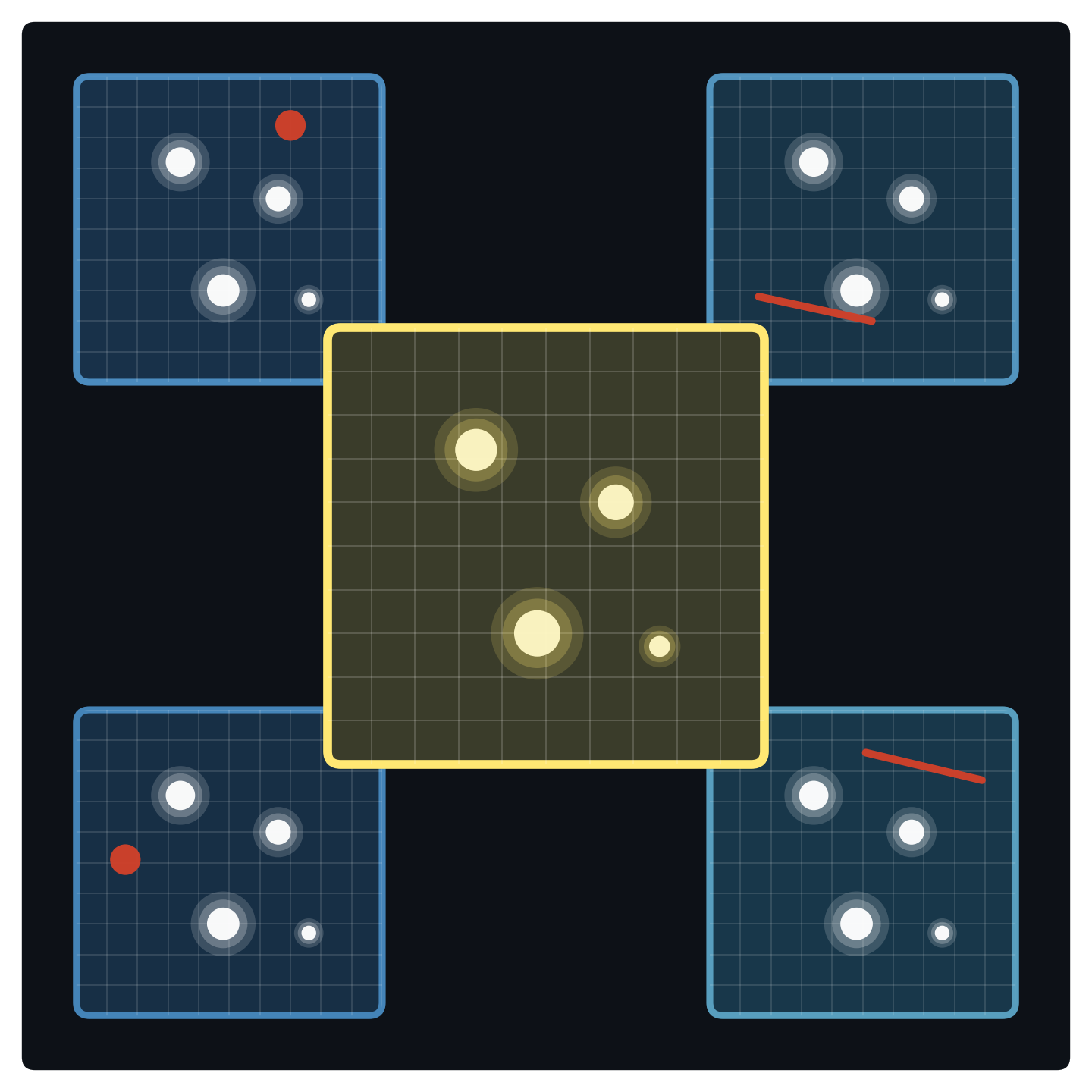
Image + Combiner + rs (Rust) = imcombiners = imc
Originally this package was developed with astronomical image combinations in mind, but it is designed to be general-purpose and should be useful for any stack combination and pixel rejection task.
0. Some Historical Notes
The skeleton of this package started in ysfitsutilpy.imutil around 2019-2020, after repeated astronomy image-reduction workflows showed that existing Astropy/ccdproc paths were not fast enough to replace IRAF IMCOMBINE in some pipelines. Later prototypes explored numba, but the final implementation uses Rust for the core kernels.
The project aims to provide a modern Python API around fast Rust kernels, with IRAF IMCOMBINE compatibility where that behavior is useful for reproducible astronomical reductions.
The package has four usage modes: Standard Combiner, compact ndcombine() wrapper, Chained Combiner, and direct kernel calls. Start with Standard Combiner for ordinary Python workflows; use direct kernel calls only when you are building a custom high-throughput layer.
The package also treats reproducibility as one of the most important targets. Where IRAF compatibility is supported, tests compare imc results against IRAF. Other comparison tests use strict assertions against Astropy/NumPy or ccdproc reference outputs where appropriate.
1. First Look
Rust-backed Python kernels combine and reject stacks along axis 0 (see below for reasons to choose axis 0, not -1). Inputs are arrays shaped (N, *spatial), which is the natural result of np.array([image for image in images]) or np.stack(images, axis=0). For ordinary 2-D image of shape (H, W), it is (N, H, W), but arbitrary higher-dimensional arrays are supported. Combination and rejection return the final output shape of (*spatial).
import numpy as np
import imcombiners as imc

rng = np.random.default_rng(20250311)
stack = rng.normal(1000, 5, (15, 256, 256)).astype("float32")

cmb = imc.Combiner(stack)
out = cmb.combine(
    "median",  # final stack-combination method
    # 1. Optional pre-rejection threshold masking
    thresholds=(0.0, 65000.0),
    # 2. Optional per-image zero/scale normalization
    zero=None,
    scale="median",
    # 3. Optional pixel rejection before final combination
    rejectors=[
        imc.MinMaxClip(n_min=1, n_max=0.1),
        imc.SigClip(sigma=3.0, maxiters=5),
    ],
    diagnostics=None,  # output-only fast path
)
Use the public API at the level that matches your workflow:
| Usage mode | Use when |
|---|---|
| Standard Combiner | You want the final image, optional zero/scale/rejection, and a cmb object you can still inspect. |
| compact ndcombine() wrapper | You want a compact function call, especially for IRAF-style or CLI-facing code. |
| Chained Combiner | You need retained masks, clipping bounds, iteration counts, or step-by-step diagnostics. |
| direct kernel calls | You have already prepared arrays and want focused imcombine primitives such as imck.sigclip_combine(...) or imck.nanaverage(...). |
All four modes share the same Rust core. Standard Combiner is the main recommended path in these tutorials. Chained Combiner does more work because it retains state; direct kernel calls are for callers who know which validation, copying, diagnostics, and object construction they can safely skip.
A convenience function place_into_padded(images, offsets) is also available for integer-pixel offset placement before combining. It accepts arrays with any shared number of trailing dimensions. Offsets are in NumPy axis order ((dy, dx) for 2-D images), and uncovered pixels are filled with NaN by default.
One dtype detail differs by mode: pure compact ndcombine() calls with combine="lmedian" preserve accepted integer dtypes, while Combiner workflows with masking, rejection, zero, scale, or weights use the normal floating workspace.
2. Rust Crate Use
imcombiners is also usable as a Rust crate. The public Rust-facing API exposes lower-level stack combine and rejection kernels.
[dependencies]
imcombiners = "<version>"
Replace <version> with the release version you want to depend on.
Build local Rust API docs with:
cargo doc --no-default-features --open3. Features
- Combine methods: mean, median, lower median (
lmed), percentiles, sum, min, max, variance, and weighted mean viaweight=on mean/average. - Rejection methods: sigma clipping, CCD-noise clipping, iterative center-relative linear clipping, min/max clipping, and IRAF-style
pclip. - Optional threshold masking, zero/scale normalization, and integer-pixel offset padding are available for common image-stack workflows.
- Iterative sigma/CCD/linear clipping,
nkeeprollback, min/max counts, and scalarpcliprank-offset behavior follow the supported IRAF compatibility model. - Public input dtypes are intentionally limited; unsupported dtypes such as
int64andfloat128are not silently cast. See Conventions for the exact dtype policy. - Rejection diagnostics use
mask, std, low, upp, nit, output_flags:stdis an array for sigma/CCD clipping andNonefor rejection methods that do not compute a standard-deviation diagnostic.
4. Rejection
| Spec | Kernel | One-liner |
|---|---|---|
SigClip |
iterative | sigma clipping with nkeep / maxrej |
CcdClip |
iterative | sigma clipping with CCD noise-model std |
LinearClip |
one-pass by default; iterative with maxiters > 1 |
center-relative affine retained bounds |
MinMaxClip |
one-pass | reject N lowest + N highest |
PClip |
one-pass | IRAF-style rank-offset percentile clipping |
Iterative sigma, CCD, and linear clipping recompute the clipping center from the current survivors each pass. LinearClip(maxiters=1) preserves the historical single-pass behavior; set a larger maxiters to iterate. IRAF-like nkeep rollback is controlled with revert_on_nkeep=True, which is the default safety mode; set it to False only for strict clipping that may leave fewer than nkeep samples. Rejection centers accept mean, median/med, and lower median (lmedian/lmed).
5. Conventions
- Stacks are
(N, *spatial). Combination and rejection always run along the stack axis (axis 0) and return(*spatial). - Terminology: the stack axis is axis 0 (
N). An output element is one location in(*spatial), such as one image pixel. Diagnostics shaped(N, *spatial)are per-sample; diagnostics shaped(*spatial)are per-output-element. Documentation avoids using “column” for axis-0 stacks because CCD images already use row/column for spatial axes. - Accepted public input dtypes are
uint8,uint16,int16,int32,float32, andfloat64. Pure stack reductions delegate toreducers: computed integer statistics such asmean,median,sum, andvariancefollowreducers/NumPy-style promotion tofloat64, while exact selectors such asmin,max, andlmedianpreserve integer dtype. Masking, rejection, zero/scale, and fused-kernel workflows still use imcombiners’ floating workspace (uint8,uint16, andint16tofloat32;int32tofloat64). Other dtypes are not silently cast. NaNandinfvalues are treated as masked by imcombiners stack reductions. This intentionally differs from NumPy and the defaultreducers.nan*behavior forinf; useignore_inf=Truewithreducersto match imcombiners.- A kernel is a function in
import imcombiners.kernels as imckthat directly uses Rust to compute a result from input arrays. - Variance is available as
Combiner(...).variance(ddof=...)or the aliasescombine="variance"/"var". It is computed from final valid values:np.nanvar(arr_eff, axis=0, ddof=ddof). Usenp.sqrt(var)if an error or standard-deviation map is needed. - Rejection kernels return a 6-tuple
(mask_rej, std, low, upp, nit, output_flags)wherestdis the per-pixel spread used by sigma/CCD clipping (Nonefor algorithms without a spread diagnostic).output_flags=0means normal completion and nonzero status bits are a bit-OR of1=pre-masked input,2=maxiters hit,4=nkeep hit,8=maxrej hit, and16=grow added rejected samples. - High-level diagnostics are controlled with
diagnostics:Nonereturns only the combined image,"simple"returns the current per-output-element diagnostics, and"full"appends a stack-shapeduint8sample_flagsarray.sample_flagsuses a separate bit namespace:1=input mask/BPM,2=non-finite,4=threshold mask,8=final algorithm rejection,16=added by grow, and32=already masked before this rejection step. - Spatial offsets use
(dy, dx)in Python/NumPy order. Photometric zero offsets use thezero=correction in combine APIs; keep these concepts separate when porting FITS/WCS workflows.
6. Memory
The current implementation works on full arrays. For a float32 input stack with size X = stack.nbytes, pure combine methods need little extra memory beyond the output. Rejection workflows typically need a boolean rejection mask and a NaN-filled working copy, so plan for roughly 2.5X total memory. Zero/scale plus rejection can require about 3X total, and integer inputs entering those workflows are first promoted to a floating workspace. Spatial chunking is planned for memory-constrained large stacks.
7. Performance
This package is built around image-stack reductions where both algorithmic work and memory traffic matter. The fastest high-level rejection path is usually Standard Combiner with diagnostics=None, or the equivalent compact ndcombine() call, because those routes can avoid diagnostic products and use fused rejection-plus-combine kernels where supported.
The detailed performance model lives in How To Get Maximum Performance:
- Implementation Tricks explains the Rust-side choices such as fused output-only kernels, scratch reuse, variance-domain sigma clipping, selective median, and rank-pair final combine.
- Scope Of The Fastest Paths explains when Standard Combiner,
ndcombine(), Chained Combiner, and direct kernel calls differ in requested work. - Workspace Requirements, Why The Stack Axis Is First, and Thread Tuning cover layout and tuning.
Recorded local imcombiners benchmark tables are in 2-D Image Benchmarks. Generic 1-D reduction benchmarks now belong to the companion reducers package.